
How to Edit AI Videos Like Photoshop: Master Runway's Aleph 2.0 Frame-by-Frame Control in 5 Steps (May 2026)
Runway's Aleph 2.0 brings Photoshop-level precision to AI video editing. Learn how to make frame-by-frame edits without regenerating your entire video in this step-by-step guide.
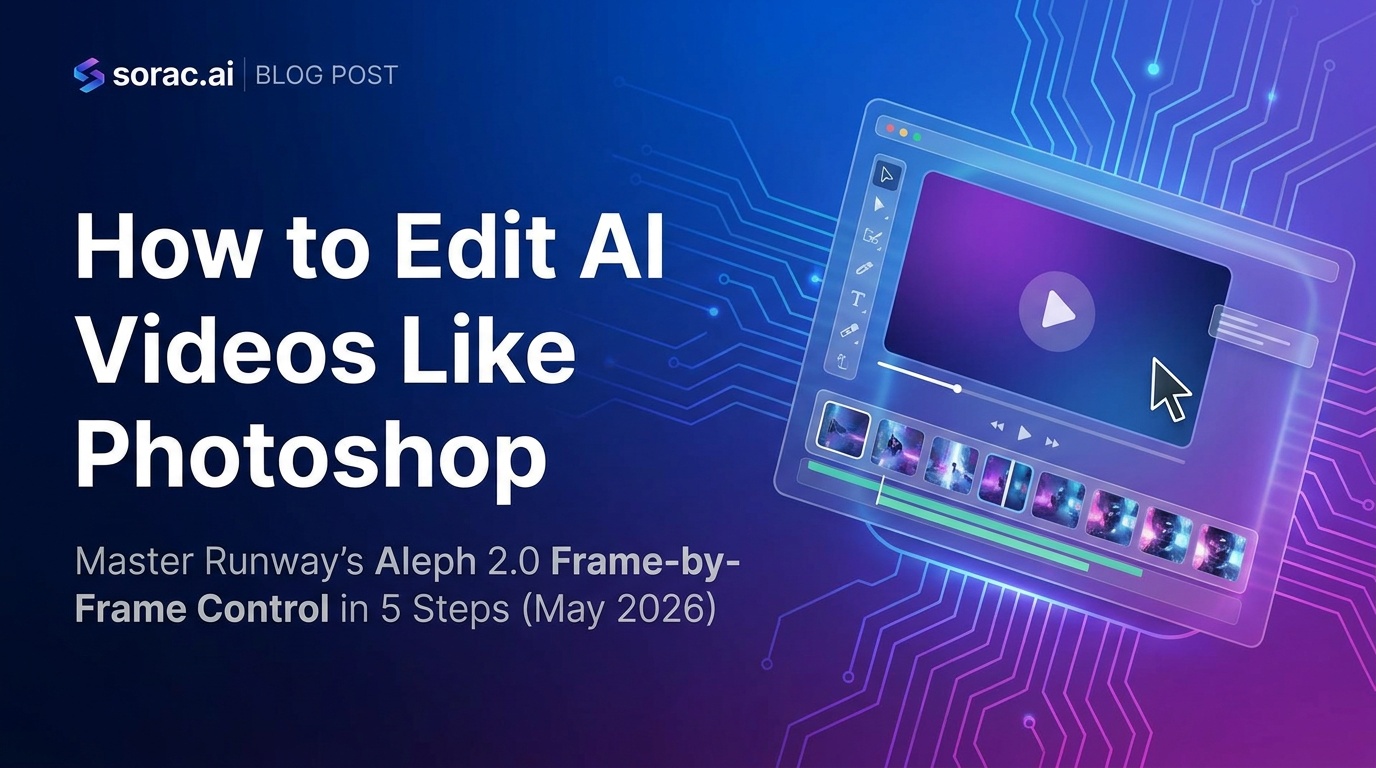
How to Edit AI Videos Like Photoshop: Master Runway's Aleph 2.0 Frame-by-Frame Control in 5 Steps (May 2026)
Remember when you generated the perfect AI video, except the product was the wrong color? Or when your AI dance video looked amazing but had one distracting background element you couldn't remove without regenerating the entire thing?
Yeah, we've all been there. Until now, editing AI-generated videos meant either accepting the flaws or rolling the dice on a completely new generation that might be worse.
Runway just changed the game on May 21, 2026, with Aleph 2.0 and their new Edit Studio interface. Think of it as bringing Photoshop's precision to video editing—you edit one frame, and the AI propagates that change through all 30 seconds of 1080p footage while leaving everything else untouched.
No more "change one thing, ruin everything" situations. Let's dive in.
What You're About to Learn
By the end of this tutorial, you'll know how to:
What You'll Need
Required:
Optional but helpful:
Pro tip: If you're just getting started with AI video generation and want to experiment before diving into Runway's pricing, try creating videos with Soracai's Sora 2 video generator first. At 5 coins per video, you can test concepts cheaply, then move to Runway for precision editing once you know what you want.
Step 1: Upload Your Video to Edit Studio
Log into your Runway account and navigate to the new Edit Studio interface (it's in the main dashboard next to Gen-4).
Click "Upload Video" and select your footage. Aleph 2.0 handles up to 30-second clips at 1080p, which is perfect for TikTok, Reels, and YouTube Shorts.
What works best:
What doesn't work yet:
Once uploaded, Edit Studio automatically analyzes your video and identifies editable elements. This takes 15-30 seconds depending on video complexity.
Step 2: Select Your Frame and Make Your Edit
Here's where the "Photoshop for video" magic happens.
Edit Studio shows you a timeline of your video. Scrub through and find a representative frame where the element you want to change is clearly visible. Click that frame to select it.
Now you have two options:
Option A: Text Prompt Editing
Type what you want to change. Examples Runway shared in their announcement:
Option B: Image Reference
Upload a reference image showing exactly what you want. This is clutch for product swaps or brand-specific changes.
Pro tip: Be specific. "Make it red" is vague—"Change to Pantone 186C red" or "Match the red from this reference image" gives Aleph 2.0 much better guidance. Same principle applies to our Nano Banana 2 Pro image generator—detailed prompts always win.
Edit Studio then generates a preview still image showing your edit on that one frame. This is brilliant because you can iterate on a single image (which takes 5-10 seconds) instead of regenerating 30 seconds of video every time.
Step 3: Preview and Refine Your Edit
Look at your preview frame. Does it match what you wanted?
If yes: Move to Step 4.
If no: Adjust your prompt or reference image and regenerate the preview. You can do this as many times as needed—it only costs you seconds, not credits, until you apply to the full video.
Runway's announcement specifically highlighted this workflow for marketing teams who need to nail precise brand colors or product details. One agency example showed them testing seven different product colorways as still previews before committing to the full video render.
What to check:
If you're seeing unwanted changes, try being more specific about what to preserve. Example: "Change sneaker to red, keep everything else exactly the same including shadows and laces."
Step 4: Apply to Full Video
Happy with your preview? Hit "Apply to Video."
Aleph 2.0 now propagates your edit through every relevant frame of your 30-second clip. The AI tracks the element you changed and applies the same modification consistently while preserving the rest of your footage.
This takes 2-5 minutes depending on video length and edit complexity. Runway says their model uses "image-level control" technology that maintains temporal consistency—meaning your red sneaker stays red and doesn't randomly flicker or morph.
Real-world use case: Imagine you created a dancing baby video using Soracai's AI Dance feature with one of our 23+ dance styles, but the background has a distracting element. Generate your dance video with us (8 coins), download it, then upload to Runway's Edit Studio to clean up the background. Best of both worlds—affordable dance generation, professional-grade editing.
Step 5: Multi-Shot Editing (Advanced)
Here's where Edit Studio really flexes.
If your video has multiple shots featuring the same element (say, a product that appears in three different angles), you can apply the same edit across all shots simultaneously.
In Edit Studio's timeline, select multiple frames from different shots. Make your edit on one frame, preview it, then apply to all selected shots at once.
Runway's announcement showed an example where a brand changed a product from blue to green across 12 different shots in a 30-second ad—one edit, applied everywhere, in under 4 minutes total.
Pro tip for content creators: This is perfect for creating seasonal variants. Shoot your content once, then use Aleph 2.0 to create summer/winter/holiday versions by changing colors, backgrounds, or props. No reshooting required.
Pro Tips from Early Adopters
Tip #1: Start with high-quality base footage
Aleph 2.0 is an editing tool, not a magic quality enhancer. If your original video is 480p and blurry, your edits will be too. Generate high-quality base videos first (Runway Gen-4, Sora 2, or Soracai's video generator all work great).
Tip #2: Combine with other AI tools for full creative control
My workflow: Generate initial video concept with an affordable tool → Use Aleph 2.0 for precision edits → Add AI effects from Soracai's trending effects for viral appeal. Each tool does what it's best at.
Tip #3: Edit backgrounds separately from subjects
If you need to change both the subject AND background, do them in separate passes. Edit the subject first, apply to video, then edit the background. Trying to change too much in one pass confuses the AI.
Tip #4: Use the preview system aggressively
Seriously, generate 10-15 preview variations before committing to the full video. Previews are fast and free (or very cheap depending on your plan). Full video renders cost credits and time.
Troubleshooting Common Issues
"My edit is flickering or inconsistent across frames"
Solution: Your reference frame might be too ambiguous. Pick a frame where the element is front-and-center with good lighting. Also, try being more specific in your prompt about maintaining consistency.
"The AI changed things I didn't want changed"
Solution: Add negative constraints to your prompt. "Change X to Y, do NOT change Z" works surprisingly well. Also, check if your reference image accidentally includes elements you don't want.
"Edges look weird or blurry around my edit"
Solution: This often happens with complex backgrounds. Try using a reference image instead of text prompts—Aleph 2.0 handles image references better for precise edge work.
"My video is longer than 30 seconds"
Solution: Split it into 30-second chunks, edit each separately, then stitch them back together in any video editor. Pain? Yes. But worth it for precision edits.
The Bigger Picture: AI Video Editing in May 2026
Runway's Aleph 2.0 launch is part of a massive shift happening right now. According to a TrendWatch field guide from early May, TikTok's For You feed is now split across six major AI video models: OpenAI Sora 2, Runway Gen-4, Kuaishou Kling 2, Stable Video 3, Google Veo 3, and Pika 2.5.
Each dominates different niches. But they all had the same problem: editing generated videos was basically impossible without starting over.
Aleph 2.0 is the first mainstream solution to "I like 95% of this AI video but need to fix one thing." That's huge for creators who don't have infinite time or budgets to regenerate content.
What this means for you:
Your Next Steps
If you're serious about AI video content:
The era of "good enough" AI video is over. With tools like Aleph 2.0, you can now demand perfection—one frame at a time.
---
Want to start creating AI videos without the Runway price tag? Try Soracai's Sora 2 video generator for just 5 coins per video, then upgrade to Runway for editing once you've nailed your concept.
Related Articles
How to Upgrade Your Kling 2.6 Dance Videos to Kling 3.0 Quality: A Step-by-Step Tutorial for Matching Pro Motion Control Without Switching Platforms
8 min read
How to Write AI Image Prompts That Actually Work in 2026: 10 Social-Ready Examples from Nano Banana 2 Pro's Prompt Library (Plus the 3-Part Formula Krea 2's Technical Report Just Validated)
9 min read

How to Generate On-Brand Product Photos Without a Designer: 5 Nano Banana 2 Pro Workflows Small Businesses Stole from Figma's New AI Stack
10 min read