
Sora 2's September Shutdown Just Triggered the Great 2026 AI Video Migration: 5 Replacement Strategies That Actually Match Your Use Case (Not Just 'Best Alternative' Lists)
Sora 2's API shuts down September 24. Here are the 5 actual migration strategies teams are using—based on what you're building, not generic "best alternative" nonsense.
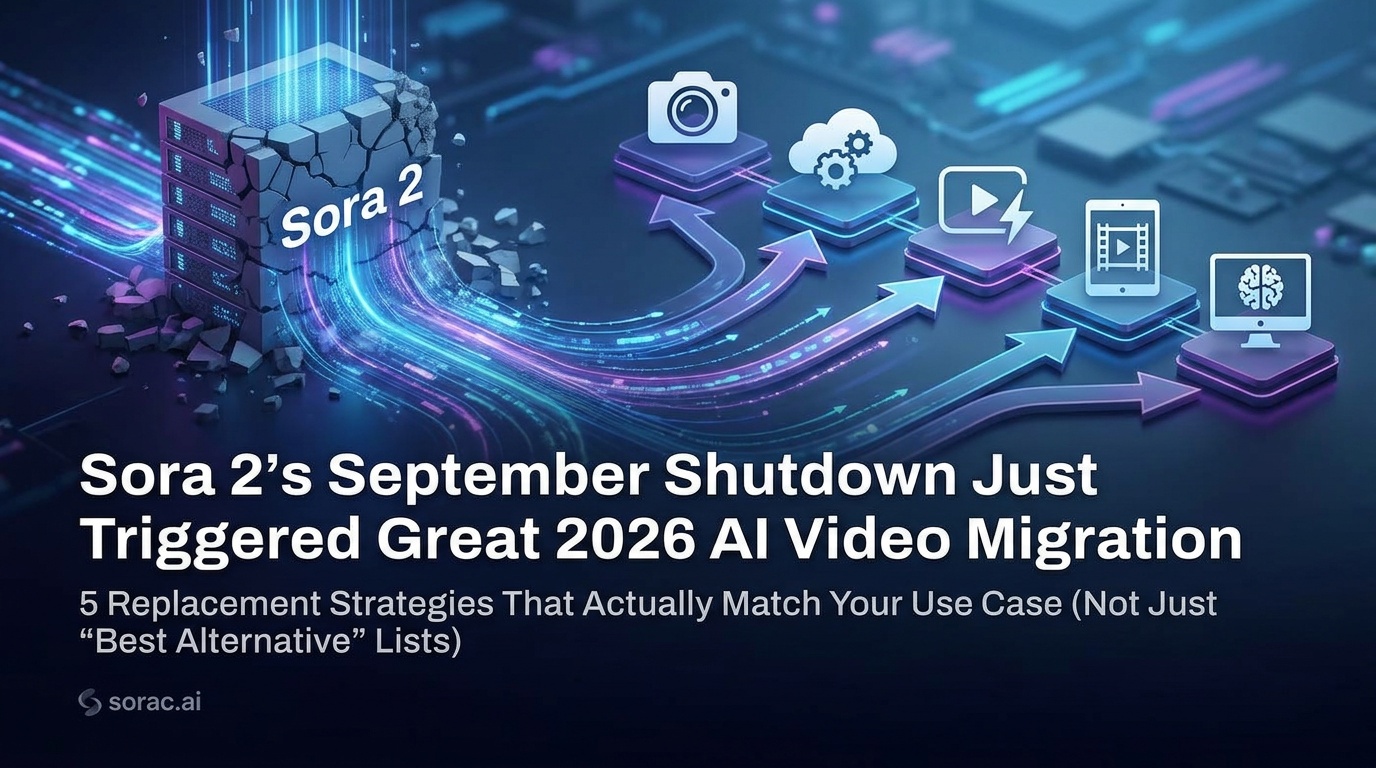
If you've been building anything on Sora 2's API, you've probably seen the calendar alert: September 24, 2026. That's not a product update—it's a funeral date. OpenAI already pulled the consumer app on April 26, and now the API has a four-month countdown clock ticking down to complete shutdown.
The AI video world is scrambling, and honestly? It's chaos out there. Everyone's publishing "best Sora alternative" listicles that treat all use cases like they're the same. Spoiler: they're not. A TikTok creator animating dance videos needs something completely different than a brand agency cutting 60-second product spots.
So let's skip the generic rankings and talk about the five actual migration strategies teams are using right now—based on what you're actually trying to build.
Why the Sora 2 Shutdown Matters (And Why "Just Use ChatGPT" Won't Cut It)
Sora 2 wasn't just another AI video tool—it was the first model that made cinematic, long-form AI video feel production-ready. The problem? OpenAI never figured out the business model. The consumer app burned through compute costs faster than a crypto mining rig, and the API pricing scared off everyone except well-funded startups.
Now we're in what the May 21 explainer called the "migration window"—four months to find a new home before sora-2 and sora-2-pro API endpoints go dark forever.
The good news? The vacuum Sora left behind has been aggressively filled. WaveSpeed's May 24 benchmark update shows Seedance 2.0 sitting at #1 for text-to-video with audio (Elo 1213), Veo 3.1 dominating enterprise cinematic work, and Kling 2.6 owning motion control. Translation: there's no single "Sora replacement"—there's a three-way split depending on what you're building.
Strategy 1: The Social-First Creator → Kling 2.6 Motion Control
Best for: TikTok/Reels creators, meme accounts, viral dance videos, anything under 15 seconds that needs movement.
Kling 2.6 isn't trying to be Sora. It's trying to be the tool that goes viral on Wednesday and crashes servers by Friday. The motion control system is absurdly good at copying reference movements—which is why it's the engine behind most AI dance tools right now.
Here's the play: instead of wrestling with raw Kling API access, use a platform that's already wrapped it in a creator-friendly interface. At soracai.com/ai-dance, you get Kling 2.6 motion control with 23+ pre-loaded dance templates—hip-hop, salsa, breakdancing, even Robot and Rockstar moves.
The workflow:
Why this works: Kling 2.6 was literally cited in the WaveSpeed benchmark as "best for motion control." You're not settling—you're upgrading to the tool designed for this exact use case. Sora 2 was overkill for 10-second dance clips anyway.
Strategy 2: The YouTube Shorts/Long-Form Hybrid → Gemini Omni Flash
Best for: Creators already in the Google ecosystem, YouTube Shorts producers, anyone who needs tight integration with YouTube tools.
Google's I/O 2026 announcement (May 19) dropped Gemini Omni Flash as the first "any-input multimodal" model—text, images, audio, video in, up to 10 seconds of video out. It's already live in the Gemini app, Google Flow, and YouTube Shorts Remix.
The killer feature? Native YouTube integration. If you're already editing in YouTube Studio or using Shorts Remix, Omni Flash is baked right in. No API wrangling, no export-import dance—just generate and publish.
The catch: It's capped at 10 seconds, and the developer API is still "coming in the next few weeks" as of late May. If you need 30+ second clips, this isn't your answer yet. But for Shorts-first creators who live inside YouTube's tools? It's the smoothest Sora exit ramp.
Strategy 3: The Cinematic/Brand Video Team → Veo 3.1
Best for: Agencies, product demos, brand storytelling, anything that needs to look expensive.
Veo 3.1 is what the May 21 analysis called the "cinematic baseline"—Google's answer to high-end commercial video. It's not trying to be fast or cheap; it's trying to replace stock footage and low-budget B-roll shoots.
The WaveSpeed benchmark positions Veo 3.1 as the enterprise/brand standard, which makes sense: Google's pitching it to the same teams that used to license Getty clips or hire production companies for $5K day rates.
When to pick Veo:
Veo isn't the most exciting choice, but it's the most defensible one if you're presenting to a CMO who's never heard of Kling or Seedance.
Strategy 4: The Budget-Conscious Builder → Soracai's Sora 2 (While It Lasts) + Nano Banana 2 Pro
Best for: Indie creators, small teams, anyone who needs pro results without enterprise budgets.
Here's the thing nobody's saying out loud: Sora 2's API is still live until September. If you're already integrated or just need a few months of runway, there's no reason to panic-migrate in May.
But smart teams are hedging. At soracai.com/ai-video-generator, you can still generate Sora 2 video (portrait 9:16 for TikTok/Reels, landscape 16:9 for YouTube, 10 or 15 frames) for 5 coins per video—no subscription, pure pay-per-use.
The parallel strategy: start building your static/thumbnail game with Nano Banana 2 Pro. It's the same coin system (4 coins for PRO mode vs 1 coin standard), and you get:
Why this matters: most viral AI videos on TikTok start with a strong static image that then animates. Generate your hero frame in Nano Banana 2 Pro, then animate it in Sora 2 (or Kling, or whatever you migrate to). You're building a two-tool workflow that survives any single platform shutdown.
Strategy 5: The Trendjacker → Viral AI Effects (No Video Generation Needed)
Best for: Meme accounts, trend-first creators, anyone chasing algorithmic distribution over production value.
Plot twist: maybe you don't need text-to-video at all. The biggest AI content on TikTok right now isn't Sora-style cinematic clips—it's one-click transformation effects.
Check soracai.com/trends for the current viral rotation:
These aren't video tools—they're viral format tools. Upload a photo, get a shareable result in seconds, ride the trend wave. No migration needed because you were never dependent on Sora in the first place.
The Real Migration Question: What Are You Actually Building?
Here's what the "best Sora alternative" lists miss: there is no best. There's only "best for X."
Ask yourself:
The Sora 2 shutdown isn't a crisis—it's a forcing function. You're about to pick tools that actually match your workflow instead of just using "whatever OpenAI shipped."
Your September 24 Checklist (Because Four Months Goes Fast)
The AI video landscape just got way more interesting. Sora 2's exit forced the market to specialize, and honestly? We're better off for it. No more one-size-fits-none solutions.
Now go pick your lane and start building. September 24 is coming whether you're ready or not.
Related Articles
Gemini Omni Flash vs Sora 2 vs Kling 3.0: Which AI Video Generator Actually Wins for Cost, Quality & Deepfake Risk in May 2026?
8 min read
Why Seedance 2.0 Will Replace 60% of Stock Footage by 2028: The Symphony-TikTok Integration That Just Changed Commercial Video Forever
8 min read
Best Nano Banana 2 Pro Alternatives in May 2026: GPT Image 2, MAI-Image-2-Efficient & 5 Others Ranked by Cost-Per-4K Image
9 min read